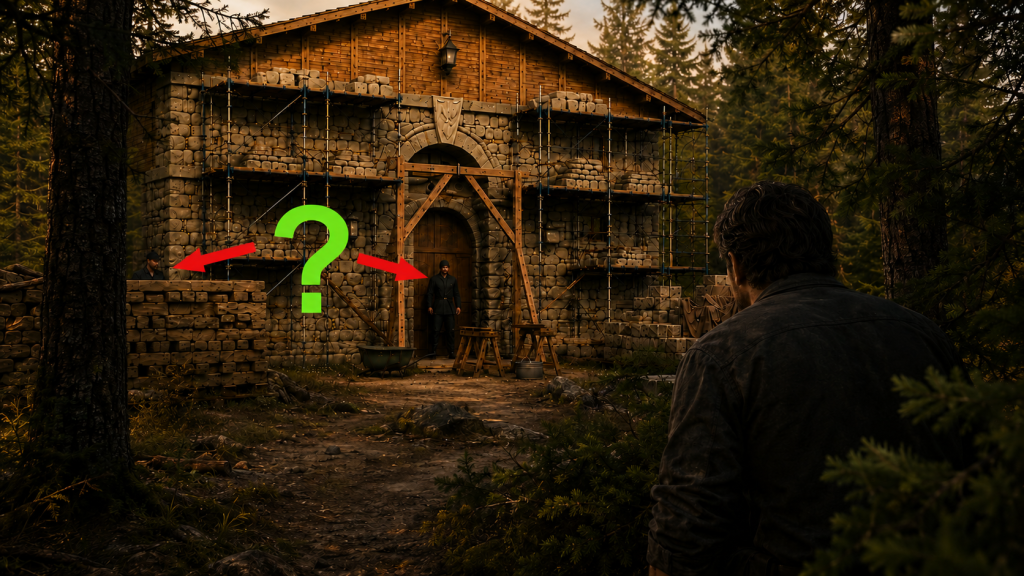
 A man stands behind a woodpile.
Another waits beneath an arch.
A third is somewhere inside the workshop with a hostage.
Nick Stello has only seconds to act.
At that moment, Dead Load: The Visual Novel Game could ask the player any number of questions. How many men did Nick see? What material was stacked beside the workshop? Which man stood closest to the entrance?
Those questions might prove that the player was paying attention. But they would not necessarily reveal how the player thinks.
A decision worth asking must do more.
More Than a Reading Test
Every designated decision in Dead Load begins with the same question:
What would Nick decide here—and why?
The game does not ask you to control Nick. His story has already been written. His history, experience, instincts, and moral limits belong to him.
You make your call before Nick makes his.
Then the story continues, and you discover what Nick actually does.
That means a designated decision cannot merely test whether you remember something stated on the previous screen. The answer should not be sitting in the text like a fact waiting to be retrieved. It must require you to interpret the situation, determine which details matter, and decide what those details mean when considered together.
Memory may help. Attention certainly matters. But neither is enough by itself.
A meaningful decision requires judgment.
Plausible Choices Matter
A decision becomes meaningless when one answer is obviously sensible and every alternative is absurd.
Suppose Nick faces three threats, but the choices include attacking an empty wheelbarrow, shouting a warning, or calmly walking away. Most players would select the only credible option. The game would learn almost nothing from that choice.
Every available response must make sense from some defensible point of view.
One option might address the closest danger. Another might focus on the man guarding the hostage’s escape route. A third might target the person who appears to pose the greatest immediate threat.
Each choice should have a rationale. Each should appeal to a different reading of the same evidence.
The question is not whether one answer can eventually be shown to align with Nick’s decision. It can.
The question is whether the other answers were reasonable enough to make the player reveal an actual preference.
Did you prioritize proximity?
Did you focus on the hostage?
Did you identify the person whose removal would disrupt the entire situation?
The value lies not only in the option selected, but in the reasoning the selection represents.
The Decision Must Belong to the Moment
A designated decision must also arise naturally from the story.
The game should not stop merely because several pages have passed and it is time to give the player something to click. The interruption must occur at the precise moment when uncertainty, evidence, and consequence converge.
Too early, and the player does not possess enough information to make an informed judgment.
Too late, and Nick’s actions may already have revealed the answer.
The decision point must preserve that narrow interval in which the situation can still be read in more than one plausible way.
You see what Nick sees.
You know what the story has allowed you to know.
Then the narrative pauses.
Make your call.
The Choice Must Reveal Something
Not every decision measures the same capability.
One may depend primarily on Attention. Did you notice the detail that changed the situation?
Another may require Synthesis. Can you connect several individually ordinary facts into a larger conclusion?
A third may emphasize Strategy, Evaluation, or Targeting. Can you determine the proper sequence, weigh competing risks, or identify the element that matters most?
Most meaningful decisions involve more than one of these capabilities. That is why a single answer cannot define an Agent.
You might align with Nick because you noticed the same structural weakness he noticed. In another scene, you might reach the same conclusion through a completely different chain of reasoning. You might also disagree with Nick while making a coherent, defensible assessment of your own.
The Agent dossier is designed to accumulate evidence across many decisions. It looks for patterns, not isolated successes or failures.
One decision is a clue.
Many decisions begin to form a profile.
Consequences Without Changing Nick
In many choice-driven games, the central promise is control. Choose one option and the story travels down one branch. Choose another and the narrative changes direction.
Dead Load makes a different promise.
Your choice does not rewrite Nick Stello.
Instead, it creates a point of comparison between your judgment and his.
That comparison only matters if the decision carries genuine stakes. You must understand that timing, injury, escape, discovery, or survival could depend on the call being made. Even though your answer does not alter the fixed story, the possible consequences must feel real enough to demand serious thought.
Then Nick acts.
You see the result of his decision. You may also see what he noticed, what he anticipated, or what he was willing to risk.
Sometimes his reasoning may confirm your own.
Sometimes it may reveal something you overlooked.
Sometimes you may still believe your answer was better.
That disagreement is part of the experience.
The Standard for Every Decision
Before a question becomes part of a mission, it should pass four tests:
- Does the player have enough evidence to make a reasoned choice?
- Are multiple answers genuinely plausible?
- Does the decision involve meaningful consequences?
- Will the answer reveal something about how the player evaluates a situation?
If the question fails any of those tests, it probably is not worth asking.
A designated decision should never exist merely to interrupt the story. It should deepen the story by making you inhabit one of its most important moments.
For a few seconds, you stand where Nick stands.
You study the same space.
You weigh the same dangers.
You make your call.
Then you find out whether you can think like Nick Stello.