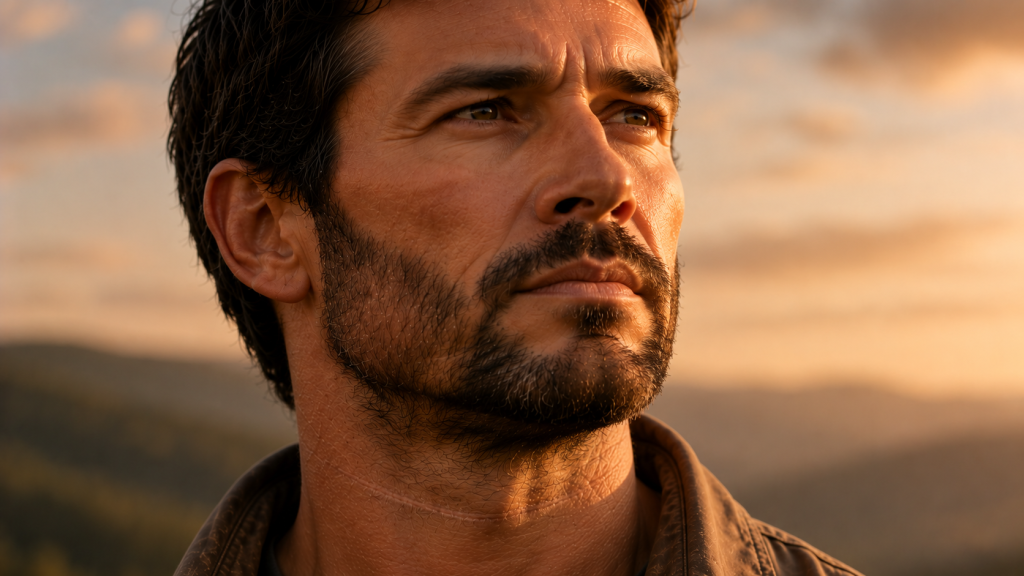
 HE KNOWS HOW STRUCTURES STAND. HE KNOWS HOW TO MAKE THEM FALL.
Nick Stello sees what other people miss.
The load carried by an ordinary length of timber. The weakness hidden inside a stable-looking wall. The single threat that matters more than the weapon everyone else is watching.
He understands how separate pieces work together—and what happens when one of them is removed.
That ability made Nick an exceptional builder.
It also made him Mason.
Nick Stello Builds
Nick is a stonemason and craftsman by inheritance as much as profession.
His father, Frank Stello, was a builder. He taught Nick to respect weight, understand materials, and recognize that the strength of a structure depends upon relationships most people never see.
A stone does not stand alone. It carries weight and transfers force. Its position gives it purpose.
Nick was fifteen when his father died of a heart attack.
Afterward, the lessons remained—but their direction changed.
The boy who had been learning how structures held together became a man exceptionally skilled at taking them apart.
Now, more than twenty-five years later, Nick has returned to building. His unfinished stone workshop in rural Vermont is not simply a construction project. It is an attempt to create a life governed by weight, balance, and rules he can trust.
Every stone he places is part of that effort.
Every stone belongs.
The Man They Called Mason
Mason was Nick’s operational name.
It was not a disguise, an alias chosen at random, or a separate personality. It described what Nick could do.
Mason understood failure.
Give him a structure, an operation, or a hostile force, and he could identify the point upon which everything else depended. He knew where pressure should be applied, what should be removed, and how apparently overwhelming strength could be turned against itself.
He did not always need explosives.
Sometimes the right tool was leverage. Sometimes timing. Sometimes misdirection. Sometimes the environment itself.
The objective was not destruction for its own sake.
It was controlled failure.
Ten years ago, on a job with his best friend Scottie Andrews, Prague showed Nick what could happen when that control was lost—or when he never possessed as much of it as he believed.
Scottie never came home.
Nick did.
Mason did not.
At least, that is what Nick has spent ten years trying to believe.
Nick and Mason Are the Same Man
Nick cannot escape Mason by pretending Mason was someone else.
They share the same memories, instincts, abilities, and responsibility.
The difference is not what Nick knows how to do.
The difference is what governs him when he does it.
When Nick uses Mason, his abilities remain subordinate to his judgment. He chooses the objective, accepts responsibility for the consequences, and stops when the purpose has been achieved.
When Mason begins to use Nick, the objective becomes everything. People become components. Damage becomes calculation. The most efficient solution threatens to become the only solution.
That is the conflict Nick carries into Dead Load.
He may need Mason to protect Kate and Noah.
He will need something stronger to keep Mason under control.
How Nick Reads a Threat
Nick does not begin with the weapon.
He begins with the structure surrounding it.
Where is the weight?
Where is the leverage?
Which threat can act first?
Which threat controls the others?
What is everyone assuming?
What does not belong?
He observes before he moves. Once he commits, every action prepares the next one.
Anger does not make him reckless. It produces something more dangerous: calm focus. His choices become faster, his movements more economical, and his attention narrower.
He does not waste motion.
He does not explain what he can demonstrate.
And when everyone else is reacting to the most obvious danger, Nick is usually studying the dependency that makes the danger possible.
The Lines He Will Not Cross
Nick is not driven by revenge.
He wants justice, but justice requires accurate responsibility. He refuses to condemn everyone merely because guilt is easier to carry when it is spread across the entire world.
Some lines remain absolute:
- He does not harm the helpless.
- He does not treat children as acceptable collateral.
- He does not betray someone who has placed trust in him.
- He does not make promises casually.
- Once he gives his word, he does not abandon it because keeping it has become dangerous.
Nick also avoids lying.
That does not mean he tells everyone everything. Silence, omission, and carefully limited answers allow him to protect truths he is not prepared to reveal.
Kate knows the difference.
She has spent ten years living inside it.
The Promise He Brought Home
Scottie Andrews was Nick’s oldest friend.
They grew up together, competed together, and entered a hidden world in which friendship became something closer to brotherhood. Scottie knew both Nick and Mason—and believed Nick was more than the weapon others saw.
Then Prague took Scottie away.
Nick returned carrying a responsibility he could neither fulfill nor release.
Kate and Noah are not assignments. They are not pieces of unfinished business. They are Scottie’s family, and protecting them is the final promise connecting Nick to the brother he lost.
That promise is part loyalty, part love, and part guilt.
It is also the lever an enemy can use against him.
When Kate is abducted, Nick does not need to decide whether he will act.
The only question is what he will allow himself to become in order to bring her back.
What Prague Left Behind
Nick’s body carries evidence of the man he used to be.
A garrote scar crosses his throat. Near his left shoulder blade is the exit wound from a 7.62-millimeter round. Neither injury explains what happened in Prague, but both make clear that Nick did not walk away untouched.
The deeper damage is less visible.
He does not fully trust the official account. He does not trust the people who gave the orders. Most of all, he does not trust his own judgment of the choices he made.
For ten years, Nick has lived as though refusing to ask further questions could keep the answers buried.
Then Julian Vance begins asking those questions for him.
Vance believes Nick Stello is Mason. Kate’s abduction is designed to force Nick to prove it.
The test succeeds.
But confirming that Mason still exists may be less dangerous than discovering what Mason brought home.
Can You Think Like Nick Stello?
Dead Load: The Visual Novel Game places you inside the same situations Nick faces.
You do not control him or decide how his story unfolds. Nick makes his own choices.
You make yours first.
You study the environment, examine the evidence, identify what matters, and record your decision. Then you discover what Nick does—and whether you understood the situation as he did.
Did you notice the same detail?
Did you identify the decisive threat?
Did you anticipate the next move?
Did you understand where the weight was going?
Each designated decision contributes to your personal Agent dossier. Your choices track how often you align with Nick while developing an ASSET Profile based upon your own demonstrated abilities.
The question is not whether you can become Mason.
The question is whether you can understand Nick well enough to know when he must use him.
Read the mission. Study the evidence. Make your call.
Can you think like Nick Stello?