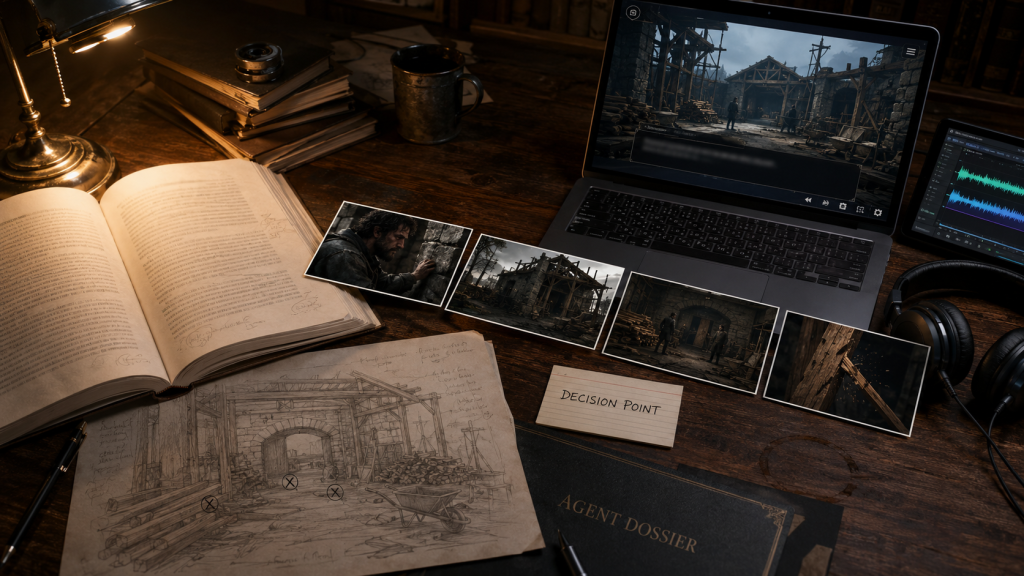
 A chapter begins with words.
A mission requires something more.
The manuscript establishes what happens, what Nick notices, and what each moment means. The Visual Novel Game must preserve all of that while adding images, sound, timing, decisions, and an Agent dossier that records how the player reads the situation.
That does not mean converting every paragraph into a screen.
It means finding the experience already hidden inside the chapter.
The Manuscript Remains the Foundation
Every mission begins with the completed prose.
The manuscript determines the sequence of events. It establishes the physical space, the characters’ positions, the information available at each moment, and the consequences of Nick’s actions.
Those elements cannot change simply because the story is entering a visual medium.
If a hostile stands behind a woodpile in the chapter, he cannot appear beneath an arch in the game. If Nick has not yet seen what is inside the workshop, the player should not receive an image that reveals it. If an object later becomes important, its location and appearance must remain consistent from the moment it first enters the scene.
The game may alter how information is presented.
It cannot alter what is true.
That makes the manuscript more than source material. It becomes the mission’s first control document.
Finding the Mission Inside the Chapter
A chapter is written to be read continuously. A mission must unfold through a sequence of visual and interactive moments.
The first production step is therefore to divide the chapter into episodes and scenes.
An episode represents a distinct movement within the chapter. It may begin when Nick notices something new, when the balance of danger changes, or when an action creates consequences that must be understood before the story advances.
Within each episode, scenes identify the individual visual beats.
A paragraph describing Nick approaching an unfinished workshop might require one wide image establishing the location. A later sentence may need a closer view because Nick has noticed a specific structural detail. An action sequence may require several images to show cause and effect clearly without reducing the moment to a confusing blur.
The goal is not to illustrate every sentence.
The goal is to identify the moments the Agent needs to see.
Deciding What the Image Reveals
Prose controls attention through language.
An image reveals everything inside the frame at once.
That difference creates one of the most important challenges in adapting a chapter.
The manuscript can mention the woodpile, then the arch, then the scaffolding. A wide image may show all three simultaneously. The player can study them in any order and may notice something before the narration calls attention to it.
That freedom is part of the experience.
It is also a responsibility.
Each image must be checked against the story’s information boundary. What does Nick know at this exact moment? What should the Agent be able to observe? What must remain concealed until later?
A useful image provides evidence without announcing its meaning.
The object should be present if Nick could see it. Its significance should remain for the Agent to interpret.
Preserving Physical Continuity
Once a location appears, it must behave like a real place.
Walls cannot shift between scenes. Doors cannot move. A wheelbarrow cannot vanish because the camera changed angles. The distance between two people cannot expand or contract merely to improve the composition.
The same rule applies to action.
If a wooden brace fails, the direction of the force matters. The frame must move accordingly. Whatever it contacts must react in a physically believable way. The next image must show the result of the previous one rather than a more dramatic but contradictory arrangement.
This requires a scene map.
The map records where characters and important objects are located, what direction they face, what they can see, and how each action changes the environment. Reference images preserve the appearance of recurring characters, structures, clothing, tools, and materials.
Continuity is not decorative perfection.
It is evidence integrity.
An Agent cannot fairly evaluate a situation if the visual facts keep changing.
Giving the Mission a Rhythm
The prose determines what happens. The game controls when the player experiences it.
A pause can make the Agent study an image more closely.
A sound can direct attention before the source becomes visible.
A transition can separate observation from action.
Silence can create more tension than music.
The timing must support the chapter rather than compete with it. If every sentence produces a new effect, the mission becomes noisy. If images and sounds arrive too slowly, the tension drains from the scene.
Each element must earn its place.
The hammer strike should feel different from the breath before it.
The sudden noise should feel different from the silence that follows.
The player should sense when the situation has shifted, even before every consequence becomes clear.
Locating the Decision Point
Not every chapter contains a decision worth recording.
When one does, it must occur at the exact moment when the Agent has enough evidence to make a reasoned choice but before Nick reveals his own.
That narrow interval is the designated decision point.
The game pauses.
The Agent receives the question and a set of plausible responses. The answer is recorded before the narrative continues.
Then Nick acts.
The player is not choosing what Nick will do. The player is committing to an assessment of what Nick is likely to do, based on the same evidence Nick possesses.
Afterward, the mission can compare the Agent’s decision with Nick’s and begin evaluating what the choice may reveal. Did the Agent emphasize proximity, sequence, structural vulnerability, immediate danger, or some other factor?
One decision cannot establish a profile.
It can provide one piece of evidence.
Connecting the Mission to the Dossier
The visible mission is only one layer of the experience.
Behind it, the game must record the Agent’s answers, preserve them between sessions, prevent the same completed decision from being scored repeatedly, and connect each response to the developing dossier.
Nick-alignment records whether the Agent anticipated Nick’s choice.
The ASSET Profile examines something different. It looks for evidence across five capabilities:
- Attention
- Synthesis
- Strategy
- Evaluation
- Targeting
A single choice may involve several of them. The game therefore cannot treat every answer as simply right or wrong. It must preserve enough context to interpret the decision as part of a larger pattern.
The dossier is not added after the mission is completed.
The mission must be designed with the dossier in mind from the beginning.
Testing the Finished Experience
A mission is not finished when the images have been inserted and the code runs without producing an error.
It must be tested as a story, a physical sequence, and an interactive system.
Does every image match the text?
Do character positions remain consistent?
Does the player receive all necessary evidence before the decision?
Does any image accidentally reveal information too soon?
Does the chosen response save correctly?
Can a returning player continue without losing progress?
Does the assessment appear once—and only once?
The mission must also be tested at full screen and at different points in the sequence. A chapter that works from the beginning may fail when launched directly for development testing. A title card may overlap the interface. A transition may leave the wrong image visible. A missing label may send the player somewhere the story never intended.
Each problem is small until it interrupts the mission.
Then it becomes the only thing the player sees.
More Than an Illustrated Chapter
The completed mission should still feel like the chapter.
The language, tension, character, and consequences remain intact. But the Agent now experiences the story through a different set of demands.
Read the words.
Study the image.
Listen to the space.
Notice what changed.
Make your call.
That is how a chapter becomes a mission.
Not by adding choices everywhere.
Not by turning the story into a collection of pictures.
It becomes a mission when every word, image, sound, pause, and decision places the Agent inside the same unfolding situation—and asks whether the Agent can understand it before Nick Stello acts.