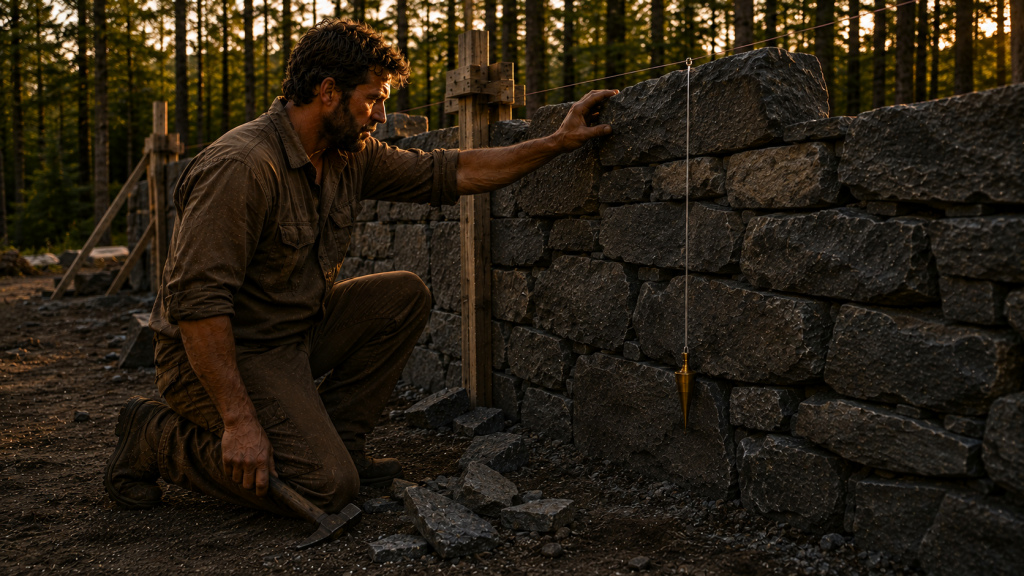
 Nick Stello builds walls.
He selects each stone, studies its shape, and determines where it belongs. He understands how the weight above will pass through it, how the stones beside it will hold it in place, and how the smallest adjustment can strengthen—or weaken—the entire structure.
The work demands patience.
It demands precision.
Above all, it demands respect for forces that cannot be seen.
Long before Nick Stello became the man once known as Mason, he learned how things stand.
That knowledge would eventually teach him how they fall.
What a Wall Reveals
To most people, a stone wall is a collection of individual pieces.
Nick sees relationships.
A stone may appear solid while resting improperly against the stones beneath it. A joint may look tight while concealing a gap deeper inside the wall. A heavy block may contribute less stability than a smaller stone placed at exactly the right point.
Strength does not come from size alone.
It comes from position, balance, friction, compression, and the path the weight follows toward the ground.
A properly built wall distributes its load. Each stone supports something and is supported by something else. Remove one piece and nothing may happen. Remove another, and the forces it had been carrying must find somewhere else to go.
That distinction is central to Nick Stello.
He does not merely notice the objects in front of him. He studies what connects them.
What carries the weight?
What prevents movement?
What appears insignificant but holds everything else in place?
Those are a stonemason’s questions.
They are also the questions that guide Nick when a situation becomes dangerous.
The Builder Came First
Nick did not begin as a destroyer.
He learned the building trade from his father, Frank Stello, a stonemason who understood that honest work leaves evidence. A wall reveals whether its builder respected the material, maintained the line, and took responsibility for what other people would eventually trust.
Stone does not care about excuses.
If the foundation is wrong, the courses above it preserve the error. If the wall is forced into alignment, the strain remains inside it. If the builder hides a weakness instead of correcting it, time and weight will eventually expose the deception.
Nick learned to read those truths through his hands.
The scrape of one surface against another told him whether a stone was seated properly. A change in resistance warned him that pressure was accumulating in the wrong place. A line that appeared straight from one angle might reveal a gradual drift when tested against a plumb line.
The work trained his eyes, but it also trained his judgment.
Do not assume that what looks permanent is stable.
Do not confuse mass with strength.
Do not ignore a small discrepancy simply because everything is still standing.
Nick carried those lessons far beyond the walls he built.
Mason Understood the Other Side
A builder studies a structure to preserve it.
A demolition specialist studies the same structure for a different reason.
The knowledge is not reversed. It is extended.
To bring something down efficiently, Mason needed to understand what was actually holding it up. Brute force could produce noise, debris, and unpredictable damage. Precision could produce a controlled result.
The critical question was rarely where a structure looked strongest.
It was where strength depended on something vulnerable.
A support.
A connection.
A sequence.
A load path.
Mason learned to identify the point where a limited action could produce a much larger consequence. He understood that the visible failure might begin somewhere distant from the force that caused it.
One element shifts.
Another inherits its load.
A brace begins to buckle.
A connection fails.
Then gravity completes what Mason started.
That is what made him effective. It is also part of what made him dangerous.
The man who understands how things are built possesses an intimate knowledge of how they can be broken.
Why the Distinction Matters
It would have been easy to make Nick a conventional action hero.
He could have been defined primarily by weapons, combat training, or physical strength. When danger arrived, he could have met force with greater force.
But that would not have made him Nick Stello.
Nick’s defining ability is not destruction.
It is structural understanding.
He reads a dangerous space the way he reads a wall. He notices which elements bear weight, which appear secure, and which relationships could change the entire situation if disrupted.
The structure may be made of stone and timber.
It may also be made of people.
One man watches the entrance. Another controls the hostage. A third depends on both of them behaving as expected. Their positions, attention, assumptions, and lines of sight form a structure of their own.
Nick studies that structure.
He looks for the equivalent of the badly seated stone or the overloaded brace. He identifies the point where pressure can be applied and asks what will move next.
He does not need to overpower every part of the system simultaneously.
He needs to understand what is holding it together.
The Name He Left Behind
Mason is more than an old field name.
It represents the part of Nick that can look at something others consider solid and see exactly how to destroy it.
That ability did not disappear when Nick walked away from his former life. He could stop accepting missions. He could put away the tools associated with Mason. He could build a quiet life measured in stone courses, honest lines, and completed walls.
But he could not forget what he knew.
When the past reaches the unfinished workshop in Dead Load, Nick faces more than the return of an external threat. He confronts the knowledge that the skills needed to protect the people before him may be the same skills he spent years trying not to use.
The stonemason wants to preserve.
Mason knows how to destroy.
Nick stands between them.
That conflict matters because destruction is not difficult for him. It is controlled destruction—used for the right reason, against the right target, without allowing Mason to take control—that carries the real danger.
The question is not whether Nick can become Mason again.
The question is whether he can use Mason without becoming Mason again.
Building After Destruction
The contrast between the stonemason and Mason is not simply a choice between two occupations or two periods in Nick’s life.
It is the central tension within him.
Building requires commitment to the future. The builder places each stone believing the wall should continue to stand after he leaves it.
Destruction compresses the future into a single result. Find the critical point. Apply force. Complete the objective.
Nick understands both impulses because both are part of him.
He knows that some structures protect people.
He also knows that others conceal what is happening inside them.
Some deserve to be preserved.
Others must be brought down.
The difficulty lies in knowing which is which—and what destroying one structure may cause the surrounding ones to carry.
That is why Nick Stello had to be a stonemason before he could be Mason.
A man who only knows destruction sees targets.
A builder sees consequences.